
When clients tell me they want analytics that “just works” without the bloat, I usually point them toward two tools: Fathom Analytics and Simple Analytics. Both are paid, privacy-first, single-script trackers built for people who are tired of GA4’s dashboards. Both skip cookies entirely. And both fit on one screen instead of forty.
But they’re not interchangeable. I’ve run both for client sites over the years, and the differences show up fast once you get past the marketing pages. Here’s an honest, hands-on look at Fathom vs Simple Analytics to help you pick the right one.
Quick Comparison Table
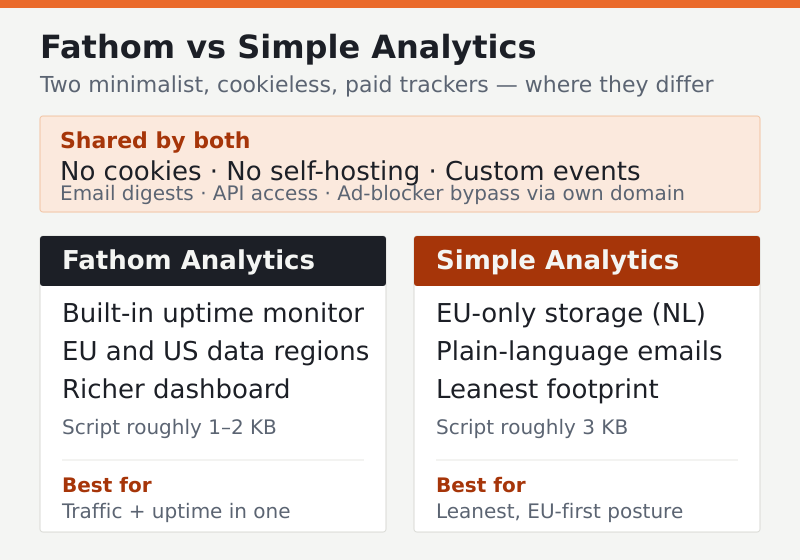
| Feature | Fathom Analytics | Simple Analytics |
|---|---|---|
| Cookies | None | None |
| Script size | Roughly 1–2 KB | Roughly 3 KB |
| Data hosting | EU and US regions | EU (Netherlands) |
| Self-hosting | No | No |
| Event tracking | Yes (custom events) | Yes (custom events) |
| Uptime monitoring | Built in | No |
| Email report digests | Yes | Yes |
| API access | Yes | Yes |
| AdBlock bypass proxy | Yes (custom domain) | Yes (custom domain) |
| Best for | Owners who want one tool for traffic + uptime | Teams who want the leanest possible footprint |
Script sizes and pricing tiers change over time, so verify the current numbers on each vendor’s docs before relying on them.
Fathom Analytics Overview — Strengths and Weaknesses
Fathom has been around since 2018 and feels like the more “complete” product of the two. The dashboard is a single page: live visitor count, top pages, top referrers, top countries, device breakdown, and a clean traffic graph. Everything you’d actually look at, nothing you wouldn’t.
What I like most is the built-in uptime monitoring. You can add your domains and Fathom pings them, alerting you if a site goes down. For a small business owner, that means one fewer subscription. I migrated a consultancy client off a stack of three tools — GA4, a separate uptime monitor, and a heatmap app — and Fathom replaced two of them outright.
Tip: Fathom’s custom domain feature routes the tracking script through your own subdomain. This sidesteps most ad blockers, which is the single biggest accuracy win you can make with any lightweight tool.
The trade-offs: Fathom is intentionally shallow. There are no funnels, no cohort retention curves, no session recordings. If you need to understand why users drop off a checkout, Fathom won’t tell you. It tells you what happened, not the narrative behind it. That’s a feature, not a bug — but only if it matches your needs.
Simple Analytics Overview — Strengths and Weaknesses
Simple Analytics leans even harder into minimalism. The product philosophy is almost stubborn about it: collect as little as possible, show only what’s useful, and store everything in the EU. For privacy officers and GDPR-cautious teams, that EU-only posture is reassuring.
One feature I genuinely appreciate is its automated email reports with a plain-language summary. It reads almost like a human wrote it: “Traffic was up this week, mostly from a Hacker News thread.” For a founder who doesn’t want to log in, that’s the right altitude of detail.
Simple Analytics also handles events and goals cleanly, and its API is well documented if you want to pull numbers into your own dashboard. I’ve wired its API into a client’s internal reporting board without much fuss.
The trade-offs: there’s no uptime monitoring, and the feature surface is even thinner than Fathom’s. If your idea of “analytics” includes anything resembling behavioral depth, you’ll outgrow it. It’s a scoreboard, not a microscope.
Head-to-Head: Privacy and Compliance
This is where both tools shine and where they’re closest. Neither uses cookies. Neither builds persistent user profiles. Neither needs a consent banner in most jurisdictions, because they don’t process personal data in the way that triggers consent requirements under GDPR. Always confirm with your own legal counsel for your jurisdiction.
The tiebreaker is data residency. Simple Analytics stores data exclusively in the Netherlands. Fathom offers both EU and US regions, so you choose. If your compliance posture demands EU-only storage and you don’t want to think about it, Simple Analytics removes that decision entirely.
Head-to-Head: Features and Accuracy
Accuracy between the two is comparable because both rely on the same core approach: a tiny first-party script, no cross-site identifiers, and an optional custom-domain proxy. When I A/B-checked both against a proxied setup, the visitor counts landed within a few percent of each other on the same site.
On features, Fathom edges ahead thanks to uptime monitoring and a slightly richer dashboard. Simple Analytics wins on the narrative email reports and its uncompromising EU stance. Neither offers funnels or session replay — if you need those, look at a product analytics tool instead. I cover that trade-off in our PostHog vs Mixpanel comparison.
Head-to-Head: Pricing and Hosting
Both are subscription products with tiered pricing based on monthly pageviews, and neither offers self-hosting. Pricing tiers change frequently, so check current rates before deciding. If self-hosting is a hard requirement, you’re in different territory — Matomo or Umami are the names to know there.
Because pricing scales with traffic, the math flips depending on your volume. For a small site, both are inexpensive. For a high-traffic site, run the numbers on each vendor’s current calculator before committing.
Which One Should You Choose?
Here’s how I steer clients:
- Choose Fathom if you want one tool that also watches your site’s uptime, and you’re comfortable choosing your data region.
- Choose Simple Analytics if EU-only data storage is non-negotiable and you love the idea of a readable weekly email instead of a dashboard you have to interpret.
- Choose neither if you need funnels, retention, or session recordings — that’s a product analytics job, not a lightweight tracker’s.
Honestly, you won’t make a bad call either way. Both respect your visitors, both load in milliseconds, and both will make you wonder why you tolerated GA4’s complexity for so long.
FAQ
Do Fathom or Simple Analytics need a cookie consent banner?
In most cases, no. Neither tool uses cookies or collects personal data in a way that triggers consent requirements under GDPR. That said, consent rules vary by country and by what else your site does, so confirm with your own legal advisor before removing any banner.
Can I export my data if I leave either tool?
Yes. Both Fathom and Simple Analytics offer data export and full API access, so you’re not locked in. You can pull your historical numbers before switching tools, which is one advantage of paid privacy-first products over scrappier free options.
Are these tools accurate compared to Google Analytics?
They count differently, so totals won’t match GA4 exactly. Privacy-first tools often report higher real numbers because they aren’t blocked as aggressively, especially when you use the custom-domain proxy. Treat them as your source of truth rather than comparing line-by-line with GA4.
Which is faster to set up?
Both take about five minutes: create an account, add one script tag to your site, and you’re live. There’s no tag manager, no data layer, and no configuration maze. If you’ve followed our Plausible setup guide, the process will feel identical.
Both Fathom and Simple Analytics prove the same point I keep making: you don’t need to track everything to understand your visitors. Pick the one whose trade-offs match your situation, add the script, and get back to building. If you want to see how these lightweight tools fit into a broader strategy, read our complete cookieless analytics guide or our roundup of GA4 alternatives.