
Choosing between Matomo and Plausible is one of the most common decisions I help clients make. Both are excellent privacy-first analytics tools, but they serve very different needs.
After implementing both platforms for dozens of companies, I can tell you this: the right choice depends entirely on what you’re trying to accomplish. Matomo vs Plausible isn’t about which is “better”—it’s about which fits your specific situation.
In this detailed comparison, I’ll break down the key differences in features, privacy, performance, and pricing so you can make an informed decision for your business.
Quick Comparison: Matomo vs Plausible at a Glance
| Feature | Matomo | Plausible |
|---|---|---|
| Founded | 2007 (as Piwik) | 2019 |
| Script Size | ~22 KB | <1 KB |
| Cookies | Yes (configurable) | No |
| Self-Hosting | Yes (free) | Yes (free) |
| Cloud Pricing | From $19/month | From $9/month |
| Learning Curve | Hours to master | Under 20 minutes |
| Heatmaps | Yes (premium) | No |
| Session Recording | Yes (premium) | No |
| E-commerce Tracking | Advanced | Basic |
| Best For | Enterprise, e-commerce | Small-medium sites |
Matomo Overview: The Enterprise Powerhouse
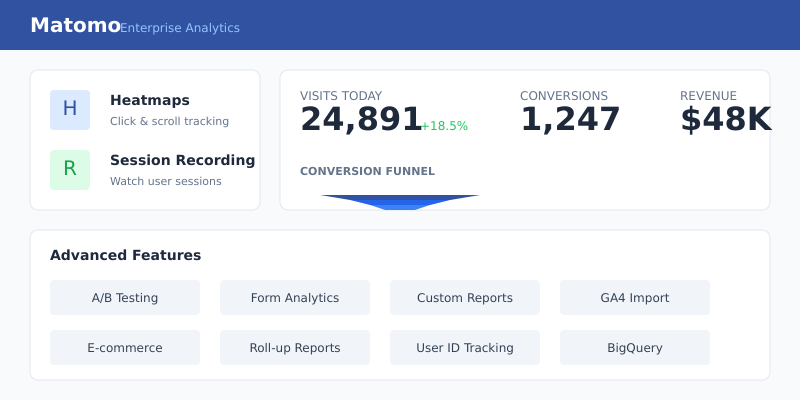
Matomo (formerly Piwik) has been in the analytics game since 2007. It powers analytics for over 1.9% of all websites, including the European Commission’s official platform. That’s a serious endorsement.
When I work with enterprise clients migrating from Google Analytics, Matomo is usually my first recommendation. It offers feature parity with GA4 while keeping all data under your control.
Matomo Strengths
- Comprehensive feature set — Everything from basic traffic stats to heatmaps, session recordings, and funnel analysis
- GA4 migration path — Can import historical Google Analytics data
- Extensive customization — Custom reports, dashboards, and A/B testing
- Plugin ecosystem — Extend functionality with dozens of plugins
- Enterprise integrations — BigQuery support, robust API, mobile SDKs
Matomo Weaknesses
- Steep learning curve — Takes hours to master the interface
- Dated UI — The interface feels older compared to modern tools
- Heavier script — 22 KB tracking script can impact page speed
- Ad blocker issues — Frequently blocked unless you use proxy setup
- Complex privacy setup — Requires configuration to be fully GDPR compliant
Plausible Overview: The Minimalist Champion
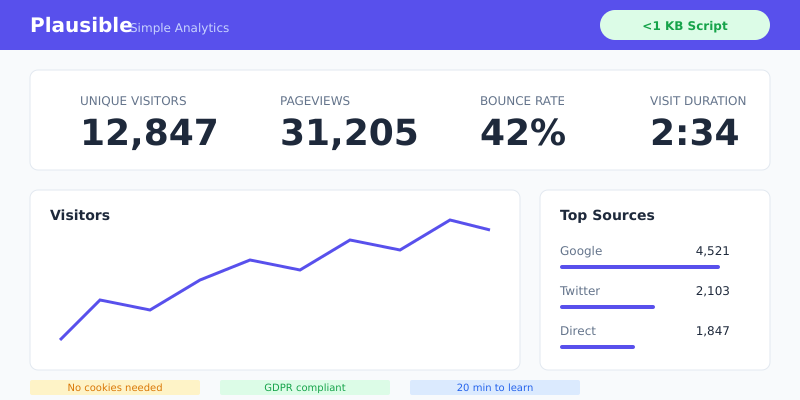
Plausible launched in 2019 with a clear mission: provide useful analytics without the complexity or privacy concerns. It’s become the darling of developers, indie hackers, and privacy-conscious businesses.
I’ve migrated several SaaS startups to Plausible, and the reaction is always the same: “Why did we ever need anything more complicated?”
Plausible Strengths
- Tiny script — Under 1 KB (45x smaller than Matomo)
- Zero cookies — GDPR compliant without any configuration
- Instant setup — Learn the entire platform in 20 minutes
- Modern interface — Clean, fast, intuitive dashboard
- Ad blocker resistant — Small script evades most blockers
Plausible Weaknesses
- Limited features — No heatmaps, session recordings, or advanced segmentation
- Basic e-commerce — Revenue tracking exists but isn’t comprehensive
- Fixed dashboard — Can’t create custom report layouts
- Fewer integrations — Limited compared to Matomo’s ecosystem
- No GA import — Can’t bring in historical data
Head-to-Head: Privacy and Compliance
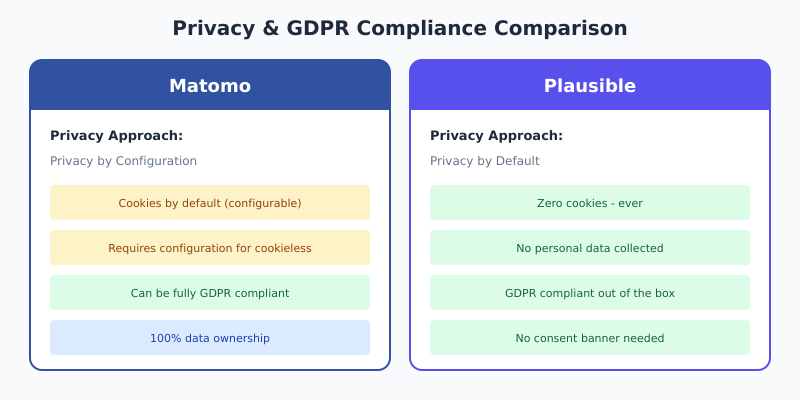
Privacy is usually the main reason people consider these tools, so let’s dig into the details.
Plausible: Privacy by Default
Plausible takes the simplest approach to privacy: don’t collect personal data in the first place. No cookies, no fingerprinting, no IP addresses stored. You’re GDPR compliant the moment you install it.
This means no cookie consent banners needed—one less thing cluttering your site and annoying your visitors.
Matomo: Privacy by Configuration
Matomo is more nuanced. Out of the box, it uses cookies and collects personal data to power features like session recordings and returning visitor identification. This requires GDPR consent.
However, you can configure Matomo to be cookieless and privacy-compliant. It takes some setup, but it’s doable. The tradeoff is losing some features that depend on user identification.
The Verdict
If privacy compliance with zero effort is your priority, Plausible wins. If you need advanced features and are willing to configure privacy settings, Matomo is viable but requires more work.
Head-to-Head: Features and Capabilities
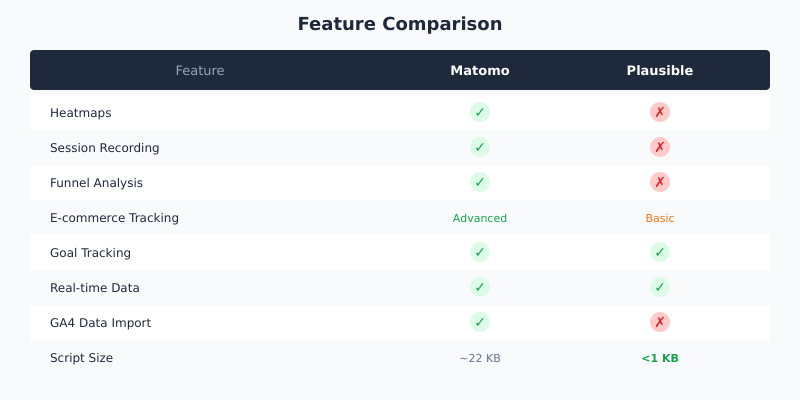
This is where the tools diverge significantly.
What Matomo Offers That Plausible Doesn’t
- Heatmaps — See where users click, scroll, and hover
- Session recordings — Watch actual user sessions (anonymized)
- Funnel analysis — Track conversion paths step by step
- A/B testing — Built-in experimentation framework
- Form analytics — See where users abandon forms
- Custom dimensions — Add your own tracking parameters
- User ID tracking — Follow logged-in users across sessions
- Roll-up reporting — Aggregate data across multiple sites
What Both Tools Do Well
- Real-time visitor tracking
- Traffic source attribution
- Goal and conversion tracking
- UTM campaign tracking
- Custom event tracking
- Geographic data
- Device and browser stats
The Verdict
For feature depth, Matomo wins decisively. But here’s the thing—most small to medium businesses never use 80% of GA4’s features. If basic traffic stats, goal tracking, and campaign attribution are enough, Plausible does everything you need.
Head-to-Head: Performance Impact
This matters more than most people realize. Analytics scripts affect your Core Web Vitals, which affects your SEO.
Script Size Comparison
| Tool | Script Size | Relative Size |
|---|---|---|
| Google Analytics 4 | ~45 KB | Baseline |
| Matomo | ~22 KB | 50% of GA4 |
| Plausible | <1 KB | 2% of GA4 |
When I migrated a client from GA4 to Plausible, their Largest Contentful Paint improved by 0.3 seconds. That’s significant for SEO and user experience.
Ad Blocker Behavior
Matomo’s larger script is frequently blocked by ad blockers and privacy extensions. You can work around this with a proxy setup, but it adds complexity.
Plausible’s tiny script often slips past ad blockers, giving you more accurate visitor counts. Some clients see 20-30% more tracked visitors after switching from blocked GA4 to Plausible.
The Verdict
Plausible wins on performance. If site speed and Core Web Vitals matter to you (and they should), the 1 KB script is a genuine advantage.
Head-to-Head: Pricing
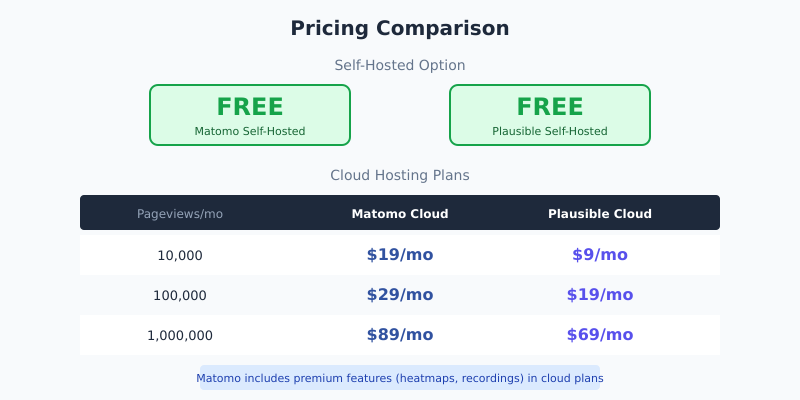
Self-Hosted (Free)
Both tools offer free self-hosted versions. You pay nothing for the software—just your hosting costs.
Matomo self-hosted requires a decent server (PHP, MySQL) and regular maintenance. Expect to spend time on updates and security patches.
Plausible self-hosted runs on minimal resources and is easier to maintain, though still requires some technical knowledge.
Cloud Pricing
| Pageviews/month | Matomo Cloud | Plausible Cloud |
|---|---|---|
| 10,000 | $19/month | $9/month |
| 100,000 | $29/month | $19/month |
| 1,000,000 | $89/month | $69/month |
Plausible is consistently cheaper for the same traffic volume. However, Matomo’s higher price includes premium features (heatmaps, session recordings) that would cost extra with other tools.
The Verdict
Plausible wins on price for basic analytics. If you need Matomo’s advanced features, the premium is justified—you’d pay more buying those features separately.
Real-World Recommendations
Based on hundreds of implementations, here’s my decision framework:
Choose Plausible If:
- You run a blog, marketing site, or SaaS product
- You want GDPR compliance without configuration
- Site speed and Core Web Vitals are priorities
- Your team doesn’t have dedicated analytics expertise
- Basic traffic, sources, and goal tracking meet your needs
- You want to spend less time on analytics and more on your product
Choose Matomo If:
- You’re migrating from Google Analytics and want feature parity
- You need heatmaps, session recordings, or funnel analysis
- You run an e-commerce site with complex conversion tracking
- You’re in a regulated industry requiring detailed audit trails
- You have technical resources for setup and maintenance
- You need to aggregate analytics across multiple properties
Can You Use Both?
Actually, yes. I’ve set up clients with Plausible for marketing teams (simple, fast, no training needed) and Matomo for product teams (deep behavioral insights).
Plausible’s tiny script means adding it alongside Matomo has minimal performance impact. It’s not the most cost-effective approach, but it works for organizations with different team needs.
Frequently Asked Questions
Is Matomo really free?
The self-hosted version of Matomo is completely free and open source. You can run it on your own server indefinitely without paying license fees. Cloud hosting starts at $19/month for managed service with premium features.
Does Plausible work without cookies?
Yes. Plausible is designed to be cookieless from the ground up. It doesn’t use cookies, local storage, or any form of persistent tracking. This makes it GDPR compliant without requiring visitor consent.
Can I import Google Analytics data into these tools?
Matomo offers a Google Analytics importer that can bring in historical data. Plausible doesn’t support GA imports—you start fresh. I recommend exporting key GA reports before migrating so you have baseline data for comparison.
Which tool is better for WordPress?
Both work well with WordPress. Plausible has an official WordPress plugin that makes setup trivial. Matomo offers both a plugin and the option to self-host on the same server. For most WordPress sites, Plausible is easier to implement and maintain.
How accurate is Plausible compared to Matomo?
Both tools are accurate for what they measure. Plausible often shows higher visitor counts because its small script bypasses ad blockers that block Matomo. The “accuracy” difference is really about what gets blocked versus what gets through.
The Bottom Line
Plausible is perfect for teams that want useful insights without complexity. It’s faster, simpler, cheaper, and privacy-compliant by default. For 80% of websites, it’s all you need.
Matomo is the choice when you genuinely need enterprise features. Heatmaps, session recordings, funnel analysis, and deep customization justify the complexity and cost for data-driven organizations.
My default recommendation? Start with Plausible. If you find yourself needing features it doesn’t have, you can always migrate to Matomo later. Going the other direction—from complex to simple—is psychologically harder even when it’s the right call.
Both tools respect user privacy and keep you in control of your data. You can’t go wrong with either—it’s just a matter of matching the tool to your actual needs.